
How Football Prediction Software Turns Data Into Probabilities
Quick Answer
How the free website model turns historical goals into probabilities, what those estimates mean, and what evidence is needed to assess performance.
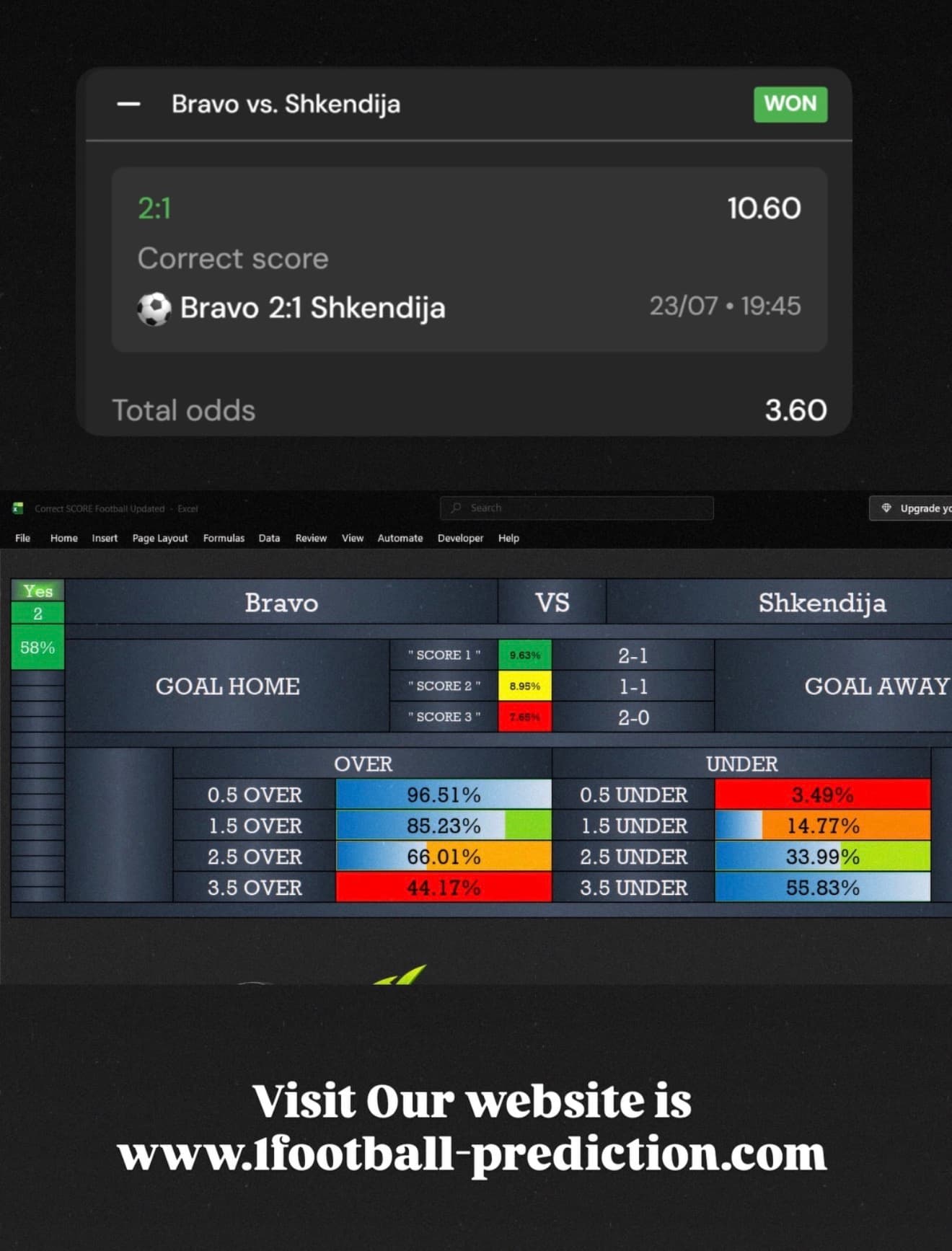
Football prediction software turns selected data into estimates of possible outcomes. Its usefulness depends on its data, assumptions and measured performance—not on whether one highlighted prediction wins.
What is documented for the free website model
Our methodology describes the free website model: historical goals are used to fit attacking and defensive strengths, with a home-advantage term and greater weight on recent results. Estimated goal rates produce a distribution of scorelines and related market probabilities.
These estimated goal rates are not shot-based expected-goals data. The website model does not analyse the quality of individual chances, injuries, lineups, weather or match importance. A paid product may work differently; its own documentation and outputs must establish that.
A scoreline is one possible outcome
Suppose a model assigns 12% to 1-1 and 9% to 2-1. That makes 1-1 more likely in the model, but leaves 88% for other scores. This is an illustrative calculation, not a live forecast or an observed success rate.
Ranking several outcomes can help explain uncertainty. It does not mean a second- or third-ranked score will usually win when the first loses. Add their probabilities to understand the total probability assigned to that set, and remember that the estimates themselves can be wrong.
How to assess whether it works
Use a forecast recorded before the event and preserve it when the result arrives. Record the model version, inputs or data source, evaluation period and selection rule. Include every eligible result, with losses and unresolved matches clearly identified.
The public track record provides recorded results for the free website model. It does not prove the performance of the paid software range. A performance claim about a paid tool needs evidence from that tool.
Consistency has limits
Software can apply a repeatable calculation, but it can still contain biased assumptions, incomplete data or implementation errors. Automation alone does not establish an advantage over another forecasting method.
Before using an output, check its fixture, time, source and limitations. Review the wider evidence rather than choosing only examples that match the final result.
Correction, 19 September 2026: Removed accidentally published database-update text and unsupported claims about shot-based data, universal product inputs and a proven predictive edge.
Predictions are statistical estimates, not guarantees. 18+. Support for gambling-related harm.