The Easy Way to Get Daily Football Predictions Without Spending Hours On It
A simple repeatable routine for producing your own daily football model probabilities in about fifteen minutes, using Excel based prediction software instead of chasing free tips online.

The Easy Way to Get Daily Football Predictions Without Spending Hours On It
Most people who follow football closely have the same problem. There are matches on almost every day of the week, the information is scattered across a dozen sites, and by the time you have read three preview articles you still have no clear view of the fixture in front of you.
The alternative is not to read more. It is to build a short, repeatable routine that produces your own numbers. Once it is set up, a full daily card takes about fifteen minutes.
Everything below produces model probabilities, not certainties and not tips. That is the point. You are building a consistent way of looking at matches, not looking for someone to tell you what will happen.
Why free daily tips are the slow way, not the fast way
It feels quicker to read someone else's daily predictions. In practice it is not, for three reasons.
You cannot see the reasoning, so you cannot tell a well argued view from a coin flip dressed up in confident language. The claims are rarely verifiable, and any site promising a fixed accuracy percentage is making a claim it almost certainly cannot substantiate. And because different sources use different methods, nothing you read on Tuesday is comparable to anything you read on Saturday.
Running your own model solves all three. Same method every day, same inputs, outputs you can compare across weeks.
The fifteen minute daily routine
Here is the routine, start to finish.
Step 1. Pick your fixtures the night before (3 minutes)
Do not try to cover every match on the card. Choose four to six fixtures from leagues you actually follow. Familiarity matters more than volume, because you will spot when a data point looks wrong.
Write the list somewhere simple. A note on your phone is fine.
Step 2. Pull the data in one pass (5 minutes)
Open one stats source, not five. Collect the same fields for every fixture in the same order: matches played, goals scored, goals conceded, and the home and away splits.
Doing all fixtures in a single pass through one site is much faster than jumping between tabs per match. This single habit is where most of the time saving comes from.
Step 3. Enter and read the output (5 minutes)
Open your workbook, type the numbers into the coloured input cells, and read the probabilities as they update. If you are covering several fixtures, keep one tab or one row per match so the whole card sits in front of you at once.
Step 4. Note where you disagree (2 minutes)
This is the step people skip and it is the most useful one. Where does the model's view differ from your own instinct about the match? Write the difference down. Over a few weeks you will learn a lot about both the model and your own biases.
Which tool to use for a daily routine
The right tool depends on which markets you follow. A few starting points from the range.
If you want exact scorelines ranked by probability, start with the Correct Score Football Software. It builds the full scoreline grid, which is the most detailed single view of a match you can get in one place.
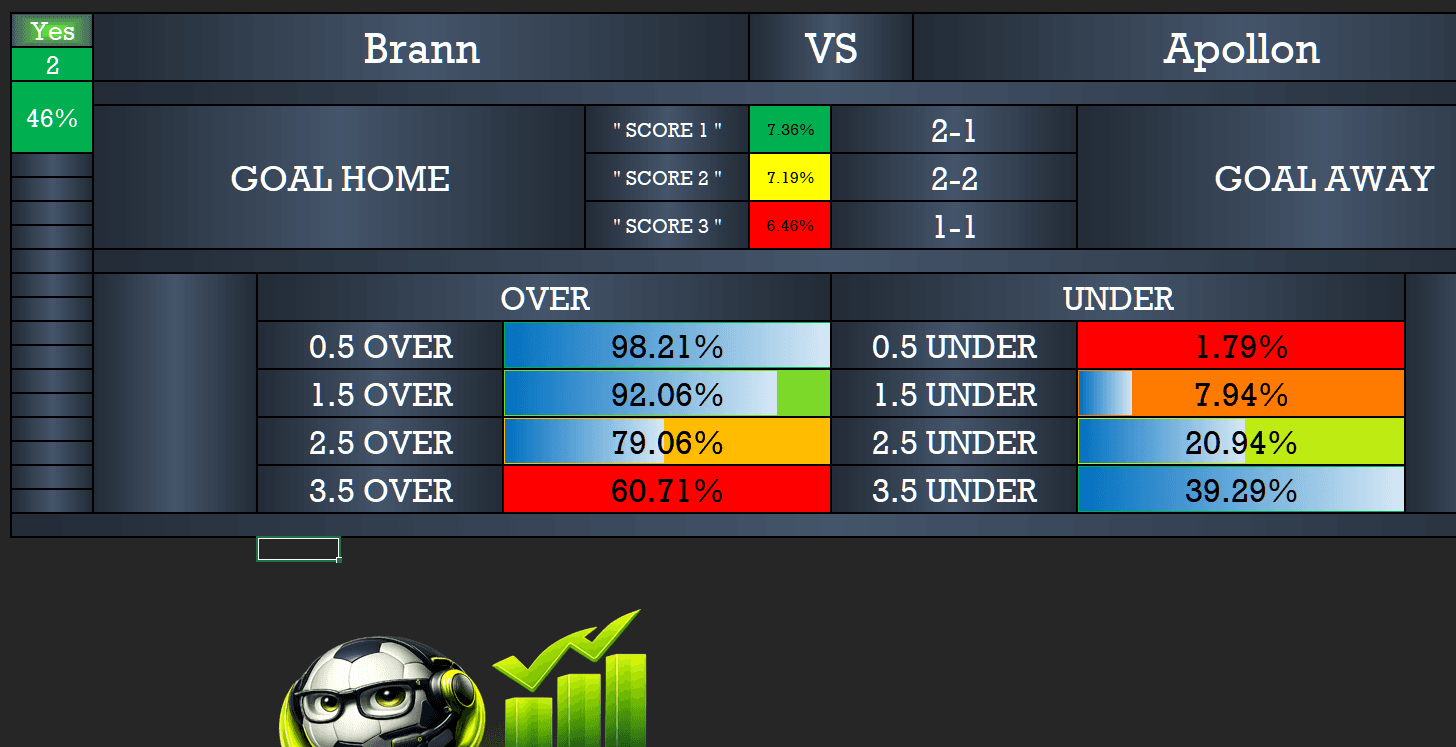
If you cover several markets at once and want them side by side, the Flash AI Predictions Software handles result, corners, both teams to score and over/under 2.5 goals in one workbook. That breadth suits a daily card better than a single market tool.
If your daily fixtures come mainly from the major European leagues, the Euro Football Prediction Software is tuned for those competitions.
And if you look at combined goals markets rather than single ones, the Combo Goals Football Software is built for exactly that.
You can browse the full range on the software shop page if none of those match how you follow football.
Three habits that make the routine stick
Same time every day. Attach it to something you already do. Fifteen minutes with your morning coffee beats an hour on a Saturday, because the daily version actually happens.
One master copy per tool. Duplicate the original workbook before you start editing. If a formula gets overwritten, you have a clean file to return to.
Keep a simple log. Date, fixture, what the model said, what happened. A single spreadsheet tab is enough. After thirty or forty matches you will have something genuinely informative about how the model behaves on your leagues. After three matches you will have nothing, so give it time.
What this routine will not give you
It will not give you certainty, and no honest system will. The model works from the data you enter, which means it cannot know about a late injury, a rotated side before a European tie, or a pitch that has been under water for two days. It does not guarantee outcomes.
What it does give you is consistency. The same lens on every fixture, every day, with numbers you can compare and a record you can learn from. That is a considerably better position than starting each matchday from scratch.
Getting set up
Pick one tool that matches the markets you already watch, download it, and run the routine on three or four fixtures tomorrow. The first day takes longer than fifteen minutes. By day three it will not.
Browse the full software range, and if you are unsure which one fits your routine, get in touch and tell us which leagues and markets you follow.
All outputs from our software are statistical model probabilities based on the data entered by the user. They are not predictions of certainty, guarantees of any outcome, or betting tips. Past performance of any model does not indicate future results.
18+. Please gamble responsibly. For free, confidential advice and support visit BeGambleAware.org.