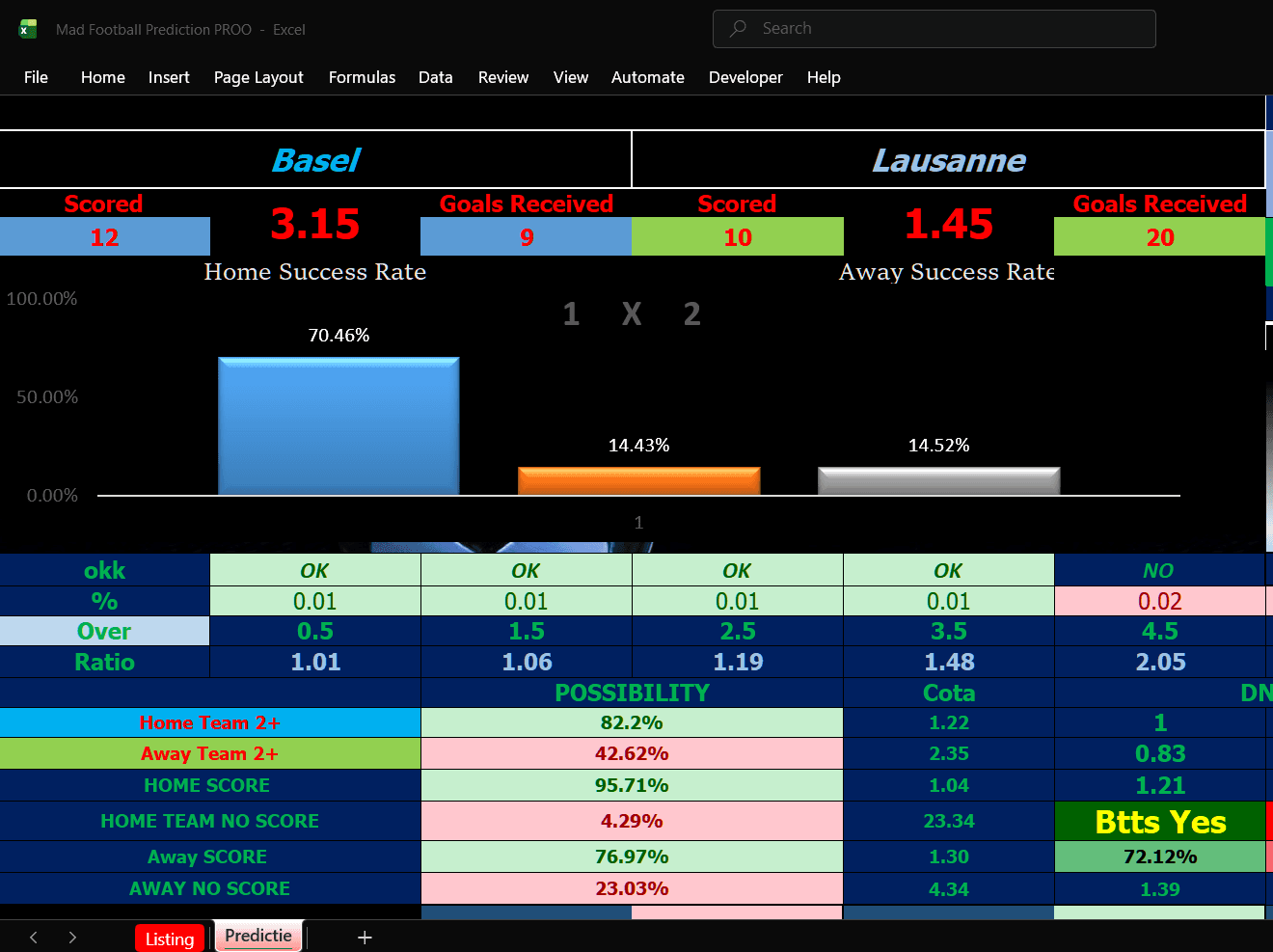
Basel vs Lausanne Prediction: 1 Aug 2026 Probabilities
Model probabilities for Basel vs Lausanne in the Swiss Super League on 1 August 2026: 1X2, over/under goals, both teams to score and correct score outputs. 18+

Basel vs Lausanne Prediction: Model Probabilities for 1 August 2026
Basel host Lausanne at St. Jakob-Park on Saturday 1 August 2026, kick-off 17:00 UK time. This page sets out what our football prediction software calculates for the fixture, covering the match result, goals markets, both teams to score and the most likely scorelines.
Everything below is a model output. These are probabilities produced from goal expectation data, not statements about what will happen. Please read the section on how the numbers are built before you use them.
Match details
| Fixture | Basel vs Lausanne |
| Competition | Swiss Super League |
| Date | Saturday 1 August 2026 |
| Kick-off | 17:00 UK, 18:00 CEST |
| Venue | St. Jakob-Park, Basel |
The starting point: goal expectations
The model builds every market from two numbers. It expects Basel to score around 3.15 goals and Lausanne to score around 1.45 goals, giving a combined match expectation of roughly 4.60 goals.
Those figures come from the scoring and conceding record the software reads in. Basel go in with 12 goals scored and 9 conceded across the sample. Lausanne go in with 10 scored and 20 conceded, and it is that concession figure doing most of the work in pushing Basel's expectation above three.
A 4.60 goal expectation is high. It is worth treating it with some caution, because early season samples are small and defensive records can shift quickly once a squad settles. The model has no way of knowing about a new signing, a suspension or a change of system.
Match result probabilities
The 1X2 output for the fixture:
| Outcome | Model probability | Fair odds |
|---|---|---|
| Basel win | 70.46% | 1.42 |
| Draw | 14.43% | 6.93 |
| Lausanne win | 14.52% | 6.89 |
The draw and the away win come out almost level, which is a normal pattern when one side has a large goal expectation edge. Lausanne's route to a result is a high scoring one rather than a low scoring one, because the model does not see them keeping Basel quiet.
Over and under goals
Because the combined expectation is 4.60 goals, the over lines carry high probabilities well up the scale:
| Line | Ratio in the sheet | Implied probability | Flag |
|---|---|---|---|
| Over 0.5 | 1.01 | 99.0% | OK |
| Over 1.5 | 1.06 | 94.3% | OK |
| Over 2.5 | 1.19 | 84.0% | OK |
| Over 3.5 | 1.48 | 67.6% | OK |
| Over 4.5 | 2.05 | 48.8% | NO |
The software flags the first four lines as clearing its internal threshold and marks Over 4.5 as not clearing it. That final line sits essentially at a coin flip, which is exactly the point where a model's confidence stops being meaningful.
Both teams to score
The model puts both teams to score at 72.12%, with fair odds of about 1.39.
That figure comes from combining each side's chance of getting on the scoresheet at all:
| Market | Model probability | Fair odds |
|---|---|---|
| Basel to score | 95.71% | 1.04 |
| Basel to fail to score | 4.29% | 23.34 |
| Lausanne to score | 76.97% | 1.30 |
| Lausanne to fail to score | 23.03% | 4.34 |
Team goal totals
For anyone looking at team-specific lines rather than the match total:
| Market | Model probability | Fair odds |
|---|---|---|
| Basel 2 or more goals | 82.20% | 1.22 |
| Lausanne 2 or more goals | 42.62% | 2.35 |
Most likely correct scores
These are derived from the same two goal expectations rather than read directly off the software display, so treat them as a secondary calculation. Correct score is the hardest market in football, and even the top scoreline here sits below 8%:
| Scoreline | Model probability |
|---|---|
| Basel 3-1 | 7.6% |
| Basel 2-1 | 7.2% |
| Basel 4-1 | 6.0% |
| Basel 3-2 | 5.5% |
| Basel 3-0 | 5.2% |
| 2-2 | 5.2% |
| Basel 2-0 | 5.0% |
| 1-1 | 4.6% |
The important context is that the eight scorelines above account for a little over 46% of the total probability between them. More than half the outcome space sits outside this table.
How these numbers are built
The software takes goals scored and goals conceded for both teams, adjusts for home and away context, and produces a goal expectation for each side. Every market on this page is then calculated from those two expectations using a standard goal distribution.
Three limits are worth stating plainly:
- The model reads historical goal data only. It has no knowledge of injuries, suspensions, squad rotation, weather or motivation.
- Early season samples are small, so goal expectations move more between rounds than they will in October.
- A probability of 70% means the outcome is expected to fail roughly three times in ten. High probabilities are not certainties.
These are model probabilities, not forecasts of guaranteed results. We publish them so you can see the reasoning, not as advice on what to do with them.
Frequently asked questions
What does the model make Basel vs Lausanne?
The model gives Basel a 70.46% probability of winning, a 14.43% probability of a draw and a 14.52% probability of a Lausanne win.
How many goals does the model expect?
Around 4.60 in total, split as 3.15 for Basel and 1.45 for Lausanne. That gives Over 2.5 goals a probability of about 84%.
Will both teams score?
The model puts both teams to score at 72.12%. That is a probability rather than a forecast, and it implies the outcome fails roughly once in every three and a half matches of this shape.
What is the most likely scoreline?
Basel 3-1, at roughly 7.6%. Basel 2-1 is close behind at 7.2%. No single correct score carries a high probability in any football match.
When is Basel vs Lausanne played?
Saturday 1 August 2026, kick-off 17:00 UK time at St. Jakob-Park in Basel.
Get the software
The probabilities on this page come from our Excel-based football prediction tools, which produce the same outputs for any fixture you enter. You can browse the full range in the store, or read more model breakdowns in our news section.
18+ only. All content on this page is provided for information purposes. Our software produces statistical probabilities and does not predict guaranteed outcomes. Gambling involves risk and you should never stake more than you can afford to lose. For free, confidential support and advice, visit BeGambleAware.org.